
The Challenge of Mass Vaccination in the Philippines
- Jose Lazar

- Feb 8, 2021
- 7 min read
When news of effective and efficacious vaccines against Covid-19 was released there was a collective sigh of relief across the world. To the weary people, normalcy is now in sight. Exactly when it’s going to be is a question they asked themselves and their governments about. For the Westerners, their government could confidently tell them that this normalcy is going to happen several months once vaccination starts, which happened in the U.S. and UK before 2020 ended. Lucky for the West. Meanwhile, people in the developing regions across the world could not be assured by their governments when they could expect their vaccine shot. There is nothing unfair or unusual here. Most Covid-19 vaccine developers are Western entities and it is both immoral and unwise if their governments will equally prioritize their citizens along with developing countries at the same time. In the first place, Western governments such as the UK and the USA have invested a huge amount of money to get these vaccines developed in the fastest time possible.
China, the country where the global pandemic originated based on available data, has been also among the first to successfully developed vaccines against Covid-19. However, like the Western governments, the Chinese government cannot afford to simultaneously prioritize its citizens and the rest of the world considering the huge population of the country. It is not easy and it cannot be quick to produce 980,000,000 doses of vaccines, which is 70% of China’s 1.4 billion people to establish a credible herd immunity among the population.

Covid 19 Vaccine
(Photo Source: Arab News)
Russia is also among the earliest to have developed a vaccine for Covid-19 and it is in the position to also ramp up production to cater both to its citizens and overseas markets. However, the economic status of the country is a constraint that could not easily be overcome.
What is clear to developing countries with neither the technological capability nor the capital to bring the production to their shores can do is to wait for when vaccine developers could meet demand across the world. Until then, developing countries must continue to approach the fight against the pandemic in the way they are doing – strict enforcement of the minimum health protocol.
That being said, let’s now explore some of the challenges the Philippine government must hurdle to vaccinate at least 70% of its population to create a viable herd immunity with the hope of stopping the pandemic.
Logistics
Broadly, commercially speaking logistics can be defined as the activity of transporting goods to customers. The Philippine governments, from the national to local, are the customers of vaccine developers. To date, our governments are in negotiation with multiple vaccine developers including AstraZeneca, Pfizer, Sinovac, Sinopharm, among others. Once these vaccine developers have produced the orders tabbed for the Philippines they will deliver the vaccines through a third-party logistics provider (3PL). Some of the 3PL providers with global reach are DHL, FedEx, UPS, DB Schenker, and Nippon Express.
Vaccines are special products that require special packaging and handling. They cannot be transported using ordinary intermodal containers or shipping containers. Instead, refrigerated containers shall be used to transport vaccines. It must obvious that the cost and handling of vaccines are not the same as transporting air fryers or raw materials for semiconductors. Vaccines are sensitive products that need precisely defined parameters for temperature, packaging, and handling. The insurance cost also of transporting vaccines is higher. Our governments have yet to divulge to the public how much the cost of transporting these vaccines. Pfizer vaccine needs -70 degrees Celcius of temperature, while other vaccines only need about -20 degrees Celcius of temperature. The usual temperature range of refrigerated containers is between -30 degrees Celcius and 30 degrees Celcius. Pfizer’s vaccine requires extra challenge in end-to-end logistics. Just to be clear, these vaccines would be transported via air cargo.

Refrigerated Intermodal Container
(Photo Source: Maersk Chiquita Web Site)

Ordinary Intermodal Container (Photo Source: Unsplash.com)

Delta Airlines’ specially designed reefer for vaccines
(Photo Source: Delta News Hub)
Warehousing
Once the vaccines arrive at the airport, we need to have warehouses to store them. Just as they need refrigerated containers and a specially designed packaging system, these vaccines would have to be stored in temperature-controlled warehouses.
As of July 2020, the Bureau of Fisheries and Aquatic Resources (BFAR) listed 103 accredited cold storage warehouses of which 27 have expired accreditation. About 80% of these facilities are located in the NCR and neighboring provinces. The rest are scattered in the Visayas and Mindanao. Most of these cold storage facilities handle products for -30 degrees Celcius in temperature good enough for most vaccines except those from Pfizer, which as we have noted above requires -70 degrees Celcius.
Whether these cold storage warehouses can accommodate the volume of vaccines that will arrive is a question our governments should have known by now. Let’s remember that these cold storage warehouses service their current clients' needs, mostly meat processors and creameries. How much spare capacity they can lend for the vaccines can be intelligently guessed to be about 20% of their capacity as this is the number most businesses allot for contingencies.
Obviously, the government needs to increase our current cold storage capacity to accommodate the arrival of vaccines for mass vaccination.
There are two options available. First, the national and local governments can ask the cold storage operators to expand their current capacities to accommodate the vaccines. Second, the governments can build cold storage facilities themselves. Obviously, the first option is more economical.

Inside a Cold Storage Warehouse (Photo Source: JOC.com)
Transportation
Once, the vaccines which arrived from abroad are stored in a cold storage warehouse, the government can now facilitate the inventory and allocation of the vaccine for transportation to specific local government units (LGUs), national government agencies, or private entities, such as big corporations with thousands of employees.
Just like in the logistics process, the transportation process required careful handling and precise observation and measurement of temperature parameters. A failure in handling could result in spoilage of the vaccines, which if not disposed for lack of careful monitoring, and then inadvertently administered to people could result in grave adverse effects or death.
Trucks that will haul the vaccines from cold storage warehouses should be capable of meeting the technical requirements regarding temperature and handling.

Reefer Truck or Refrigerated Closed Van (Photo Source: Transportify.com.ph)
Distribution
Once the vaccines were turned over to LGUs, national government agencies, and private entities they will need to be kept in proper refrigerated packaging to avoid exposure and spoilage. Again, proper handling, monitoring, and safety protocols must be in place. Most LGUs may have to invest in a stand-alone refrigeration system to store the vaccines, and some have already acquired refrigerated Coleman.
LGUs and private entities must be critical in handling the vaccine. They should be strict in observing safety protocols to avoid exposure and spoilage. And they should create an organizational system that can effectively audit, inspect, and monitor the movement, handling, and storage to ensure that only those vaccines that are free of elemental or environmental exposure and spoilage are administered to people. Lives are at stake here.

Refrigerated Coleman
(Photo Source: eBay.com)
Vaccination
Within the National Capital Region (NCR) most LGUs have started or are starting to simulate their vaccination program. Some of the LGUs have created a process flow or process map of how they will conduct the vaccination. In San Juan City, they even timed the process to measure how many people can be processed within a given day. While in Marikina they created a HACCP-based forward process flow to ensure maximum safety in the vaccination process while increasing efficiency. The IATF on Emerging Diseases has started to check on LGU’s level of preparations and have taken notes on those processes that could be considered best to share it with other LGUs.
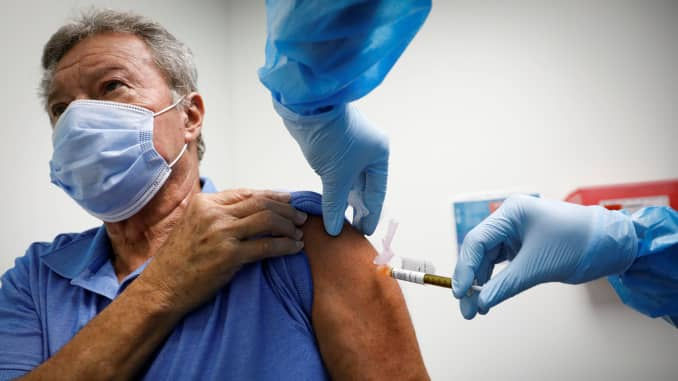
A Man Receiving Covid-19 Shot in the USA
(Photo Source: CNBC)
The NCR has an estimated population of 13 million. On average it takes 8 minutes for an individual to get vaccinated. This means that a single Vaccination Line can only process 60 individuals in 8 hours, considered one full workday. So, in 7 days a single Vaccination Line can only process 420 individuals and in a month 1,680 will be processed.
In Muntinlupa City, to make an example, the population stands at about 500,000, if the LGU will deploy say 100 Vaccination Lines, it will be able to vaccinate all 500,000 residents in 83.4 days. In other words, it will take the Muntinlupa City LGU about 4 months to inoculate all its residents utilizing 100 Vaccination Lines operating in an 8-hour a day set up. If the LGU could deploy 200 Vaccination Lines, they can process all the residents in 2 months. This process would have to be done twice for the booster shot. Of course, these numbers are based on the most optimistic scenario when vaccine supplies are good, properly handled, and housed in a suitable cold storage warehouse.

Muntinlupa Leaders Cong. Ruffy Biazon and Mayor Jimmy Fresnedi
Leading the LGU preparation for Covid-19 Vaccination
(Photo Sourced from Cong. Biazon’s Facebook Account)
With the above ideas, let’s explore some questions that can help LGUs become more effective and efficient in their vaccination program:
1. How many Vaccination Line they intend to create for their vaccination program?
2. Are they training personnel who shall administer the vaccine?
3. How many personnel can they deploy for the vaccination program?
4. How many personnel should manage each Vaccination Line?
5. Are they preparing a list of the names of people who shall be vaccinated first?
6. Are they scheduling their residents for vaccination?
7. How are they preparing their residents for vaccination?
8. How do they plan to monitor the vaccine recipients?
9. What resources have they prepared to respond to vaccine recipients showing adverse reactions?
10. How shall these resources be deployed for individuals who show serious adverse reactions that need hospitalization?
These questions can help our LGUs and even the government to more efficiently and effectively conduct the mass vaccination program.
LGUs in the NCR and surrounding provinces are in a better position to handle mass vaccination. This is not so for LGUs in the rest of the country. The role of the private cannot be understated if we as a nation are to win the fight against the pandemic. It is in the interest of both the public and private sectors to create a herd immunity at 70% of the population to stave off a deeper and more serious impact of the pandemic on the economy and society.
The question, can the government and the private sector working hand-in-hand inoculate 70% of the population within a year? The honest answer is I believe in the negative. There are simply too many variables and challenges that need to be overcome, chief of which is the sheer cost of the end-to-end logistics of the vaccine.
IP Note:
The photos used were sourced from various sites on the Internet. They are used for illustration purposes only with no intention of infringing on the owner's rights.


Comments